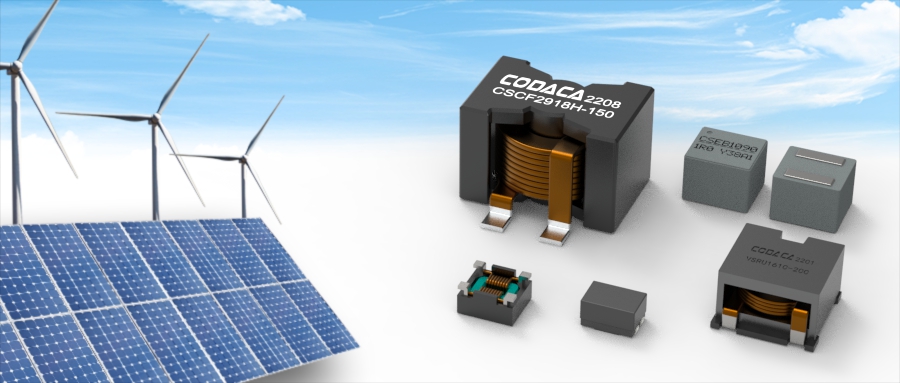
Among different renewable energy sources, solar and wind energy are the most widely developed and applied. Photovoltaic panels have been widely installed globally, especially in regions or operating environments where there is little opportunity to obtain electricity from the public grid or where no grid infrastructure has been established at all. Their ease of construction and flexible cost have made solar energy very important to regional energy structures. In wind farms, the power generation capacity of several megawatts has greatly facilitated the process of achieving carbon neutrality, making it an important commercial source of electricity.
However, due to the instability of power levels dependent on sunlight duration or wind strength, conversion efficiency and control of upward power feeding to the grid have become issues of great concern in power engineering.
Sensors and measurement units applied to power quality and voltage levels are present in almost every power stage, from power generation to transmission to inversion. These crucial real-time signals are necessary to support the central controller in carrying out corresponding operations and driving the control gates of different external HV or LV switching FETs (such as SiC, IGBT). In such power applications, many large power components or devices are widely used to withstand high voltage or transients, ensuring a longer service life for stable performance and thereby reducing the failure rate of the entire device or system. Furthermore, to accomplish these management tasks, independent power supplies and reliable power distribution to all functional or operational units are essential. Components of smaller size (compared to those used in power lines) that possess both a reliable lifespan and enhanced environmental impact resistance would be suitable choices.

 English
 中文版
中文版